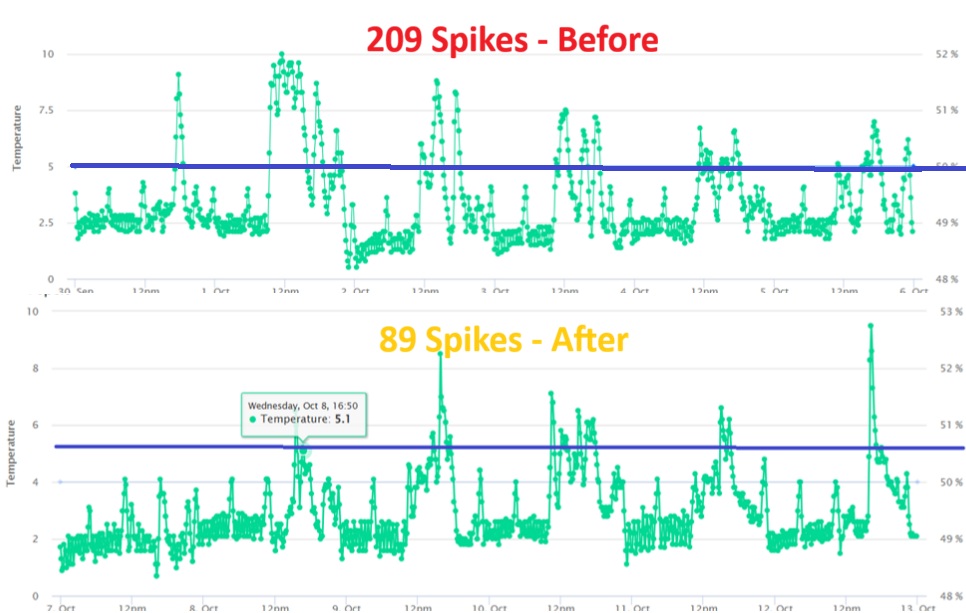
We ran a case study installing PVC strip curtains in the coolroom of a restaurant kitchen. The setup was simple – our digital temperature loggers tracked conditions one week before installation, one week after. The goal was to see if a basic environmental control such as strip curtains could reduce the temperature fluctuations that create food safety risks and drive up energy costs.
The Numbers Tell Half the Story
When the results were in, the average morning temperature dropped one degree. Not dramatic, but still significant.
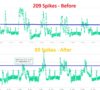
But the number of temperature readings exceeding 5 degrees? That dropped from 209 spikes down to 89 — a 56% reduction.
Here’s what most operators miss: those spikes matter more than the average temperature ever will. When your coolroom hits 9 or 10 degrees (or more), you’re not just dealing with a number on a screen. The equipment works harder to compensate. High-risk foods like meat and seafood enter the danger zone. Temperature fluctuations above 5°C don’t just risk spoilage — they stimulate rapid growth of food borne pathogens and impact food quality.
And the condensation from those temperature swings? That’s a breeding ground for mould and other pathogens that you can’t see until the problem becomes expensive.
The Hidden Cost of “Good Enough”
Business owners don’t realize they have a problem until they see the data.
Most don’t have access to real-time coolroom temperature monitoring — they’re working blind, assuming their refrigeration is doing it’s job. Using digital temperature loggers (sensors) , we showed one operator exactly what was happening every time staff opened the coolroom door during service. Refrigeration accounts for roughly 44% of all electricity usage in commercial kitchens. Every second a door stays open, cold air escapes and the compressor runs harder.
Even with the curtains installed and that 56% improvement, 89 temperature spikes still occurred. Those remaining fluctuations affect equipment through excess wear and tear. This leads to emergency repairs instead of scheduled maintenance.
Emergency commercial refrigeration repair typically costs $500 to $1,200. Preventive maintenance? $150 to $400 per visit.
Why Simple Solutions Fail (And It’s Not the Curtains)
Here’s what I still see though – staff behaviour can completely undermine the solution.
We’ve seen curtains hooked up out of the way because staff found them annoying. We’ve seen operators leave doors open longer, assuming the curtains were doing all the work. When that happens, the temperature data tells the story immediately — spikes creep back up, energy consumption rises, and the 56% improvement disappears.
PVC strip curtains work. But only if people use them correctly.
That’s where digital temperature loggers become the accountability tool. When we can show that temperature spikes are climbing again because curtains are hooked aside, the conversation shifts from theory to reality. Generally managers aren’t standing over the kitchen staff watching every move to notice the pattern until someone points it out.
What This Actually Means for Your Operation
If you’re deciding whether PVC curtains and temperature monitoring sensors make sense for your operation, here’s the business case beyond “it’s the right thing to do.”
Energy consumption drops when temperatures stay stable.
The numbers are clear. When refrigeration isn’t fighting constant temperature swings from door openings, it runs more efficiently and costs less to operate and maintain.
For operators who already maintain high food safety standards, this becomes validation rather than intervention. You get peace of mind that your standards are being achieved — with data to prove it when you need to.
The lesson I learned from testing this – simple changes can make a significant impact on both food safety and operating costs. You don’t need complex systems. You need the right tool used correctly, with visibility into whether it’s actually working.
The 56% reduction isn’t the finish line. It’s the starting point for understanding what’s really happening in your operation — and what it’s costing you when you can’t see it.
If you want to see what’s actually happening in your fridges — and how simple solutions like this could improve your food safety and reduce costs, contact Trinity on 0415 168 729 to find the best option for your business.